HOW DO COGNITIVE BIASES INFLUENCE MARKETING COMMUNICATION?
Through my experience in marketing, I have become increasingly aware of the importance of understanding how our individual and collective minds work. This has led me to ask questions such as: Why do we buy what we buy? How can information unconsciously penetrate our conscious mind, making us remember certain brands and products? How can we protect our attention from being monopolised by advertising? Or, on the contrary, what does it take to capture our customers’ attention in an era where attention has become a scarce resource?
While reading the research paper “Cognitive Biases in Marketing Communication: Influence of Anchoring and Message Framing on Consumers’ Perception and Willingness to Purchase” (2021), I found it interesting to see how marketing and advertising communication evolved during the 1970s. Communication moved from simply providing information about a product’s characteristics to associating brands with a desired lifestyle, creating an emotional connection with the brand, and appealing to consumers’ aspirations and identity when making a purchase decision.
SYSTEMA 1 AND SYSTEM 2
And when it comes to making decisions, we rely on two systems: a fast one and a slow one, according to research by psychologists Wason and Evans (1974), Stanovich (1999), and Daniel Kahneman (2011). While System 2 requires greater effort and attention, System 1 operates automatically and does not require conscious control. It is also more susceptible to cognitive biases.
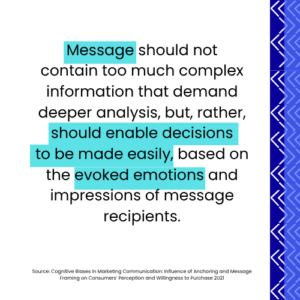
When a communication message activates and demands more from System 2, it can become less persuasive. This led to the idea that communication should avoid overly complex information requiring extensive analysis. Instead, messages should be simple and emotional, allowing the recipient to make decisions more easily, as discussed by psychologist Daniel Kahneman.
But if System 1 is prone to cognitive biases when making fast decisions, how can we recognise these biases to avoid making poor decisions? And, from a marketing perspective, how can we use this knowledge to create messages that consumers can easily remember and associate with our brand or product?
Cognitive bias
According to “Cognitive Biases in Fact-Checking and Their Countermeasures: A Review” (2024), there are more than 221 identified cognitive biases. With so many of them, we are naturally vulnerable to several at the same time. These biases act as mental shortcuts that help us make decisions faster, but faster does not necessarily mean more accurate.
This is precisely why cognitive biases have become relevant to advertising and marketing. Those who understand and recognise the power of some of the most influential biases, such as anchoring, can use them more effectively in their communication.
If you run a business or are about to launch a new product, you should assume that your competitors are very likely already applying some knowledge of these biases to their communication. If it is working for them, how can you identify what they are doing right?
Here are four cognitive biases frequently used in marketing and advertising:
1. Anchoring Bias
Anchoring bias refers to the tendency to rely too heavily on a particular piece of information, typically the first information acquired, when making a decision. This bias can occur when people assess multiple sources of information and use an initial reference point to evaluate subsequent information — Stubenvoll & Matthes, 2022.
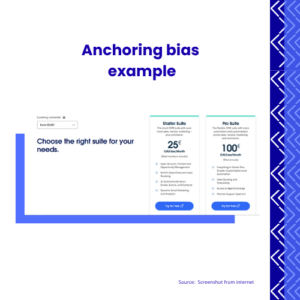
Example: SaaS companies often display their most expensive plan first, followed by more affordable options. The purpose is t
Pic 1o establish a high price as an initial reference point, against which the other options are then evaluated. If your goal is to encourage a first purchase by making it appear less risky, imagine offering a Pro Suite for €100 followed by a Standard plan for €25. Potential buyers may perceive the €25 option as a great deal or a “fair” price because they have already seen the €100 option.
The actual value of the €25 service has not changed. What has changed is the reference point against which the customer evaluates it.
2. Halo Effect Bias
The halo effect is the tendency to attribute greater accuracy or credibility to the opinion or characteristics of an authority figure or entity, regardless of the specific content being evaluated — Javdani & Chang, 2023.
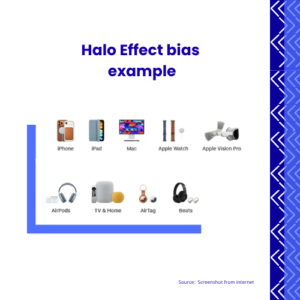 Example: Apple is a clear example of a strong brand halo effect. Initially known primarily as a computer company, its reputation has extended to many of its other products. Consumers often perceive these products as having the same level of quality, design and sophistication associated with Apple’s computers.
Even when some of its products may not outperform competitors in every category, being part of the Apple brand ecosystem can influence how consumers perceive their quality.
The same mechanism can occur when brands support social or environmental initiatives, associating themselves with the values represented by those causes. Consumers may purchase a product because it reflects what they believe in and value, transferring those positive associations to the brand or product.
But there is a warning here: If a brand does not behave consistently with the values it communicates, consumers may react against it, accusing the company of misleading communication or greenwashing. In that case, the same halo effect that previously strengthened the brand can turn into a reputational risk.
3.Scarcity Bias
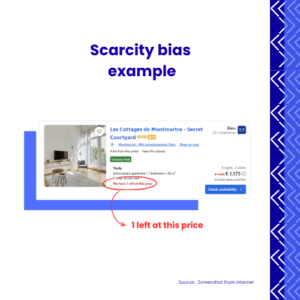 Scarcity bias refers to the tendency to perceive opportunities as more valuable when their availability is limited — Cialdini, 2007.
Example: Hotels and booking platforms frequently use scarcity to encourage consumers to make faster decisions. Messages indicating that only a few rooms remain available can create a sense of urgency and encourage people to complete their purchase.
However, brands and companies that overuse this technique can create the opposite effect. If consumers discover that the scarcity message is exaggerated or misleading, they may become more sceptical and question the credibility of the brand.
Scarcity can create urgency, but only when the scarcity is genuine.
4. Social Proof
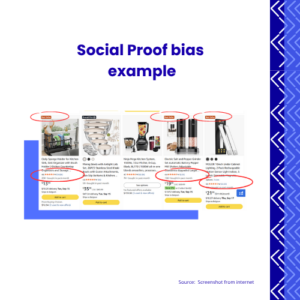 Social proof is the tendency to perceive a behaviour as more appropriate or correct when we see other people performing it — Cialdini, 2007.
Example: We can clearly see this in products labelled as “best sellers” on Amazon, particularly when combined with high star ratings and a large number of reviews. The more people appear to support the same opinion, the more likely consumers are to be influenced by that collective judgement. A product may not necessarily be the best option within its category, but if it is the one appreciated by the largest number of people, it may have a greater probability of attracting additional buyers.
—
 These cognitive biases are just a few examples of mechanisms that companies use every day, often without consumers consciously analysing what is happening — particularly when purchasing decisions are emotional.
However, overexploiting these biases can eventually lead to fatigue and scepticism. This is why marketers need to understand a broader range of cognitive biases and use them to adapt communication while keeping the information truthful.
For consumers, simply pausing before making an impulsive purchase can also make a difference. Taking a moment to think can increase the likelihood of considering other brands or products that may actually better satisfy their needs and expectations.
In my next article, I will explore a question that many entrepreneurs, marketers and business professionals ask themselves: How do you communicate your product or service in a way that captures the attention it deserves?