



How to Adapt the Purchase Journey to the Growing Use of AI Agents
The way people make purchasing decisions is changing. Not because consumers have stopped researching before buying, but because they are increasingly relying on AI assistants to help them do it. Instead of visiting multiple websites, comparing products manually, or reading dozens of reviews, many buyers now begin their journey by asking ChatGPT, Gemini, Claude, or other AI tools to summarize the market for them.
While reading several recent reports on this emerging behaviour, one publication particularly caught my attention: Deloitte’s The State of Agentic Commerce in Europe. What I found especially interesting was not only the statistics, but the practical framework the authors proposed for businesses: Be Found. Be Chosen. Be Trusted. Three simple principles that perfectly summarize how companies should prepare for this new purchasing environment.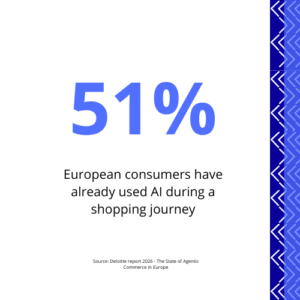

According to Deloitte, 51% of European consumers have already used AI for shopping, and another 27% are willing to do so. Although the study focuses on retail, its conclusions are equally relevant for B2B companies, as AI is becoming an increasingly important touchpoint during the discovery phase of any purchase journey. Understanding this shift is no longer optional—it is becoming essential for any company that wants to remain visible and competitive.
Although this suggests that AI-assisted shopping is becoming an increasingly common habit, consumers still draw a clear line between receiving recommendations and delegating decisions. Respondents rated AI as highly valuable for providing information (5.3 out of 7), but showed much lower willingness to let AI make purchasing decisions on their behalf (2.3 out of 7).
This finding aligns closely with another study conducted by Ipsos, How Artificial Intelligence Is Reshaping the Purchase Journey, which surveyed consumers across multiple countries beyond Europe. The research found that only 24% of consumers would allow AI to choose what it believes is the best option for them.
So, how are consumers actually using AI when they shop?
Both studies point to the same conclusion: consumers primarily use AI to research and compare options.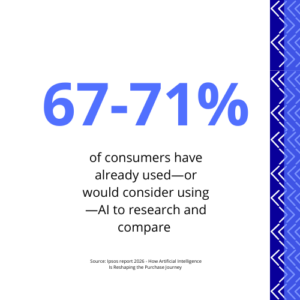
The Ipsos report notes that between 67% and 71% of consumers have already used—or would consider using—AI to research and compare products during their purchasing journey.
This behavior is gradually becoming a new habit. While younger generations are naturally leading the adoption, the trend is steadily expanding across older age groups as well.
These findings clearly indicate that as consumers increasingly rely on AI to research products, services, and brands before making a purchase, businesses need to adapt their marketing and commercial activities accordingly—without losing sight of relationship building.
In practical terms, your business needs to ensure that AI tools can easily discover, understand, and recommend your products or services during the early stages of a buyer’s research process.
How does this change your purchase journey?
For years, Google has been the primary gateway for discovery. Businesses invested heavily in SEO because appearing in search results meant being found by potential customers. Today, a new touchpoint is emerging within the discovery stage of the purchase journey: AI-powered search.
Consumers are increasingly turning to tools such as ChatGPT, Gemini, Claude, or Perplexity before they even visit a search engine or a company website. Deloitte’s framework offers a useful way to rethink this new reality.
1. Be Found: Ensure that your digital content is easy for AI agents to understand and retrieve. Implementing Generative Engine Optimization (GEO) becomes essential if you want your business, brand, products, or services to appear in AI-generated recommendations.
2. Be Chosen: Being visible is no longer enough. Your offer must clearly communicate why it is different from competing alternatives. Whether your competitive advantage is price, quality, innovation, sustainability, or customer support, AI systems need enough structured information to recognize those differentiators and recommend your solution over others.
3. Be Trusted: While Deloitte originally applies this principle to conversational AI assistants, I believe it extends naturally to your content strategy. Transparent communication, accurate information, expert knowledge, and credible sources all contribute to building trust—not only with your audience, but also with AI systems that increasingly evaluate the reliability of the information they present.
A practical example of applying these insights
Not long ago, the entire purchasing journey was carried out by a human being—from researching available options to making the final decision. Today, a significant part of that journey is gradually being delegated to an AI assistant.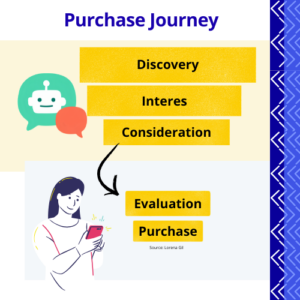

Rather than replacing the buyer, AI acts as a research partner. It helps users discover information, organize it, summarize alternatives, and compare products before they make a decision.The buyer remains in control, but reaches the evaluation stage much faster.
However, during the evaluation phase, consumers still want to conduct their own research before committing to a purchase. They often consult additional sources, visit company websites, read reviews, or speak directly with sales representatives.
In other words, consumers are not ready to delegate the final decision to AI.
They see AI as an intelligent assistant that simplifies research, comparison, organization, and planning—saving significant amounts of time—but they still prefer to make the final choice themselves.
Let’s imagine your business sells kitchen appliances:
- A potential customer wants to buy a new refrigerator. Instead of immediately browsing multiple retailer websites, they open ChatGPT and ask about available refrigerator types, leading brands, price ranges, and energy-efficient models.
- They provide additional context, such as the size of their household, the available kitchen space, and their desired energy savings.
- ChatGPT then generates a shortlist of products. The customer refines the request further by asking for the top three or five options based on price, warranty, and local availability.
- The AI produces an easy-to-read comparison table highlighting the most relevant features.
- Only then does the customer visit a physical store or a manufacturer’s website, speak with a sales advisor, clarify details such as installation or delivery, and finally make the purchase.
This example illustrates how AI is reshaping the early stages of the purchase journey. Instead of evaluating dozens of options, consumers now begin with a curated shortlist generated by AI. If your business is not visible during this first stage, you risk being excluded before the buyer even discovers your brand.
—


As users become more familiar with AI tools, their expectations—and their purchasing habits—will continue to evolve.
If your target audience consists primarily of younger consumers or digitally native professionals, adapting your marketing strategy to AI-driven discovery should become a priority.
If, on the other hand, your audience is more mature, you can adjust your tactics progressively, following the pace at which your customers adopt these new technologies.
Regardless of your market, one thing is becoming increasingly clear: AI is not replacing the buyer—it is reshaping how buyers discover, evaluate, and narrow down their options. Businesses that adapt their digital presence to this new reality will be better positioned to earn visibility, trust, and consideration long before the final purchasing decision is made.